
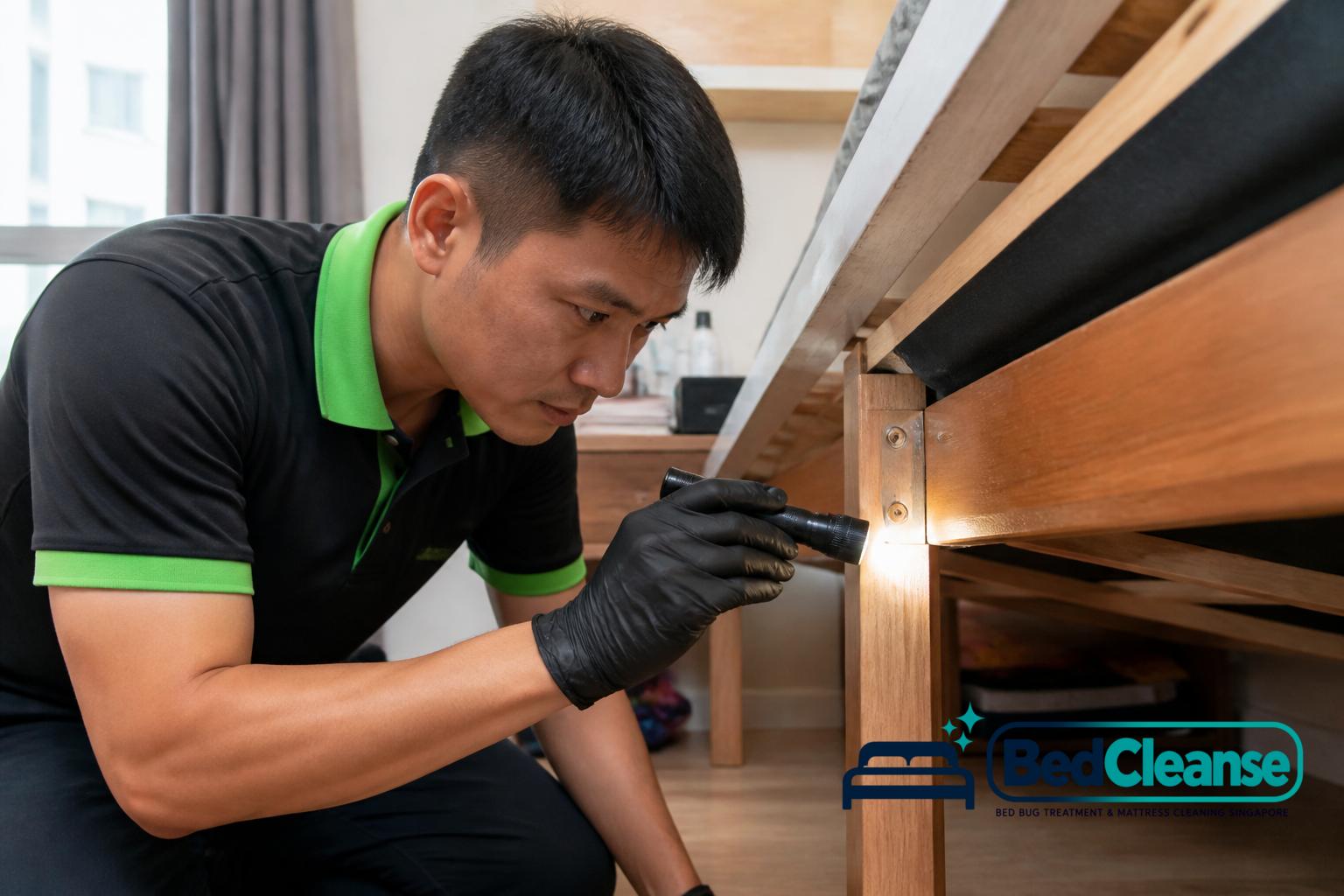
A professional bed bug inspection in Singapore is a careful identification job, not a treatment session. The technician’s role is to look for signs of activity, trace possible harbourage points and assess how far the issue may have spread within the unit. In an HDB flat, condominium or landed home, that usually means checking sleeping areas, upholstered furniture and the nearby crevices where bed bugs tend to hide out of sight. The aim is to confirm whether the problem is likely to be bed bugs, and to map the places that may need targeted follow-up.
What the inspector is looking for
During a proper inspection, the technician will focus on visual evidence rather than applying anything presumptively. Common areas inspected include mattress seams, piping, tufts and labels, as well as bed frame joints, slats, screw holes and the back or underside of headboards. If there is a sofa or daybed in the room, those upholstery edges, stitching lines and cushion gaps may also be checked, since bed bugs often move between resting areas and nearby soft furnishings.
In Singapore homes, inspection also extends to practical hiding spots around the bed area, such as skirting edges, cracks in walls, bedside tables, curtain folds and any clutter close to the sleeping zone. The technician may use a torch and a probing tool to inspect tight corners where spotting by eye is difficult. This is about finding harbourage, not assuming the infestation level before evidence is seen.
How the inspection is usually carried out
The process is typically systematic. First, the inspector asks where bites, sightings or stains were noticed, and whether the issue appears limited to one bedroom or has turned up in more than one room. That helps decide which parts of the unit need closer checking. In a compact HDB bedroom, for example, the inspection may cover the bed, side tables and adjacent wall areas more quickly, while a larger landed home may require a broader sweep across multiple sleeping spaces.
Next, the technician examines the sleeping setup piece by piece. Mattress seams are lifted and checked, especially along folds and buttons. The bed base, frame and headboard are inspected for cracks, joints and hidden recesses. If there is upholstered furniture nearby, the cushion zips, underside fabric and arm joints may also be reviewed. A good inspection is methodical because bed bugs can be very good at staying tucked away in narrow spaces.
Signs that may be recorded during the inspection
The inspector may note several types of signs, depending on what is visible at the time of visit. These can include live bed bugs, shed skins, small dark droppings, eggs in seams or crevices, and staining around resting areas. Sometimes there are no insects seen on the day, but the pattern of evidence still points towards harbourage in or around the sleeping area.
- Live insects in seams, joints or upholstery folds
- Molts or shed skins from nymphs
- Dark spotting on mattress edges, bed frames or fabric
- Eggs or eggshells in hidden crevices
- Clusters of activity around the bed, sofa or nearby furniture
It is important not to confuse a strong suspicion with a confirmed diagnosis. A proper bed bug inspection should separate likely signs from other issues such as general dust, fabric staining or unrelated insect activity. That distinction matters before any treatment plan is discussed.
What happens after the inspection findings are confirmed
Once the inspection is complete, the technician should explain where signs were found and what the likely next step is. If bed bugs are confirmed, the follow-up is usually a targeted treatment plan directed at the affected harbourage areas rather than a blanket approach. The purpose is to address the places where the insects are hiding, not to treat every surface in the home indiscriminately.
If the inspection suggests the problem may be larger than one room, the technician may recommend checking adjacent areas or additional furniture. That can be especially relevant in Singapore apartments where bedrooms are close together or where a sofa is used frequently for resting. The inspection outcome should help decide what needs attention, and in what order.
Why inspection matters before any treatment
Bed bug control works best when the infestation pattern is properly identified first. Without inspection, it is easy to miss hidden harbourage in mattress seams, bed frame joints or upholstered furniture. It is also possible to waste time treating an area that looks suspicious but is not the main source of activity. A thorough inspection gives the technician a clearer picture of where the insects are active and what type of follow-up makes sense.
For Singapore households, this can also help with practical planning. In a condo or HDB setting, residents may need to coordinate access to the bedroom, shift furniture away from walls or prepare adjoining rooms for a wider look. In landed homes, inspection may take in multiple sleeping areas, guest rooms or lounges if there are signs that the insects have spread beyond one bed.
How a professional inspection differs from mattress or sofa cleaning
It is useful to keep bed bug inspection separate from mattress cleaning, mattress deep cleaning, sofa cleaning and sofa deep cleaning. Cleaning is a fabric-care service focused on dirt, stains, odour and hygiene on the material itself. Inspection, by contrast, is about checking for pest evidence in seams, joints and hidden crevices. These are related only in the sense that the same bed or sofa may need both services at different times.
Ordinary cleaning alone should not be viewed as a complete bed bug solution. A technician may vacuum or inspect fabric during the visit, but that is not the same as pest treatment. If bed bugs are present, the issue requires a proper pest-focused plan after inspection, not just a cleaning pass over the surface.
What you can prepare before the technician arrives
Before the inspection, it helps to make access easy and keep the affected areas clear. Do not throw away the mattress or dismantle the bed unless you have been advised to do so, because that can make tracing the source harder. Instead, if possible, reduce clutter around the bed, keep bedding available for review and note any recent sightings or bite patterns you have observed.
If the issue involves a sofa, a guest bed or another piece of upholstered furniture, it helps to know when it was last used and whether signs have appeared there as well. In Singapore homes, a few clear notes and photos can make the inspection much more efficient, especially if more than one room may be involved.
If you would like to arrange a visit, WhatsApp BedCleanse Bed Bug Treatment & Mattress Cleaning Singapore about the exact service in the title. For bed bug cases, share the affected rooms, signs observed and photographs if available; for mattress or sofa cleaning, include the item type, fabric, stains, size, address and preferred appointment. Cleaning alone should not be treated as a substitute for pest treatment.
Conclusion
A professional bed bug inspection in Singapore is a careful, evidence-based check of mattresses, bed frames, headboards, sofas and nearby hiding places. It helps identify where bed bugs may be harbouring and whether the issue is limited to one area or has spread further. By separating inspection from treatment and from fabric cleaning, homeowners get a clearer next step and a more appropriate response for their HDB flat, condominium or landed home.
Choose BedCleanse Bed Bug Treatment & Mattress Cleaning Singapore
At BedCleanse Bed Bug Treatment & Mattress Cleaning Singapore, we specialise in helping households manage bed bug infestations from the initial signs through to more thorough treatment. We begin with a bed bug inspection to identify affected areas around mattresses, bed frames, sofas and nearby spaces before carrying out the appropriate bed bug treatment. If the infestation has spread across several parts of the home, we use a broader bed bug pest control approach, while bed bug extermination is carried out for more established cases that require a more comprehensive level of treatment.
Our services cover commonly affected areas such as mattresses, bed frames, sofas and surrounding spaces, allowing us to address infestations according to their extent and the areas involved. Alongside treatment, we carry out mattress cleaning for regularly used sleeping surfaces, while mattress deep cleaning provides a more thorough clean where heavier dirt and buildup are present. For upholstered seating, sofa cleaning helps clean commonly used fabric surfaces, with sofa deep cleaning providing a more intensive clean when needed.
Visit our blog for practical information on bed bugs, mattress care and upholstery cleaning, or browse our portfolio of projects to see examples of work we have completed. For bed bug treatment and related mattress or sofa cleaning enquiries, WhatsApp us today at +65 8241 0032 to speak with our team.
Frequently Asked Questions
What will a bed bug inspector check first?
The inspector usually starts with the sleeping area, especially mattress seams, bed frame joints, headboards and any upholstery close to the bed. These are the most common places where bed bugs hide during the day.
Will the technician treat the room during an inspection?
Not usually. A proper inspection is for finding signs and mapping harbourage. If bed bugs are confirmed, the technician may then explain the next treatment steps separately.
Can sofa cleaning replace a bed bug inspection or treatment?
No. Sofa cleaning is for fabric care, stain removal and hygiene. It does not replace a bed bug inspection or a pest-focused treatment plan if infestation signs are present.